

Winterizing Your Concrete: Why Road Salt is Destroying Your Fishers Driveway
Protect your driveway this winter! Learn why road salt destroys concrete, how J&J General Solutions engineers slabs for freeze-thaw cycles, and what to use instead.
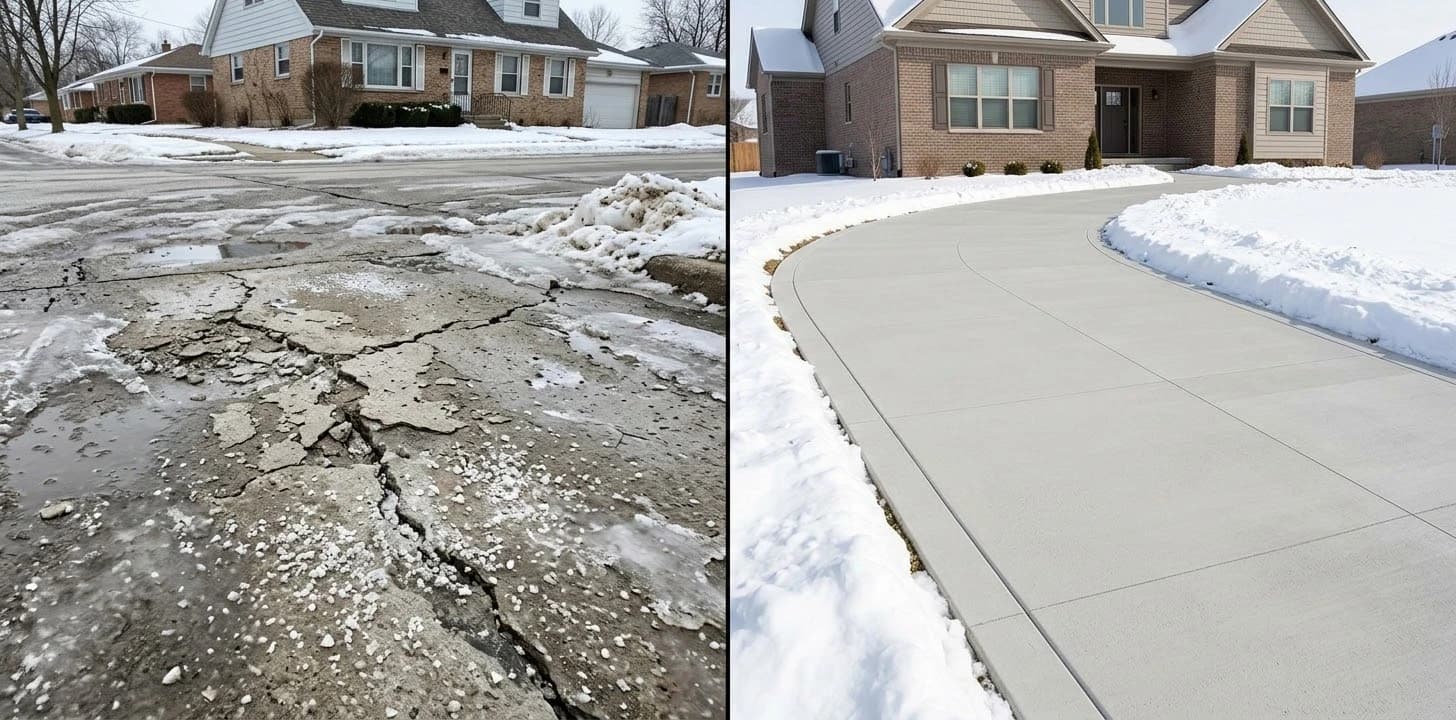
A severely cracked and spalling concrete driveway in Central Indiana suffering from severe winter freeze-thaw and salt damage.
Central Indiana winters are notoriously unforgiving. From heavy lake-effect snow down to freezing rain, keeping your driveway clear is a constant battle. For many homeowners in Fishers, Carmel, and Indianapolis, the immediate reflex is to grab a heavy bag of road salt or chemical de-icers to melt away the hazard.
But while that salt might melt the ice today, it is actively destroying your concrete tomorrow.
If you want to protect your investment and avoid costly premature replacements, understanding proper concrete winter care in Indianapolis is essential. Here is why road salt is your driveway's worst enemy, and what you should be doing instead.
The Science of Salt Damage: Freeze-Thaw Destruction
To understand why salt is so damaging, you have to understand the "freeze-thaw cycle." Concrete is a porous material, meaning it absorbs water just like a hard, dense sponge.
When you apply road salt or chemical de-icers, it lowers the freezing point of water. This turns ice into a liquid brine that absorbs deeply into the surface of your driveway. However, once the temperature drops low enough (as it inevitably does during an Indiana winter), that trapped brine freezes again.
When water freezes, it expands by about 9%. That expansion exerts immense internal pressure on the concrete. Because the salt allowed more water to penetrate deeper into the slab before freezing, the resulting pressure literally blasts the top layer of your driveway apart. This process leads to scaling, spalling, crumbling, and deep structural cracks.
The Safe Alternative: How to Treat Your Driveway in Winter
If you have recently had a new driveway poured, proper winter maintenance is critical. At J&J General Solutions, we have a strict rule for our clients:
- No chemical de-icers or road salt for the first 1-2 winters.
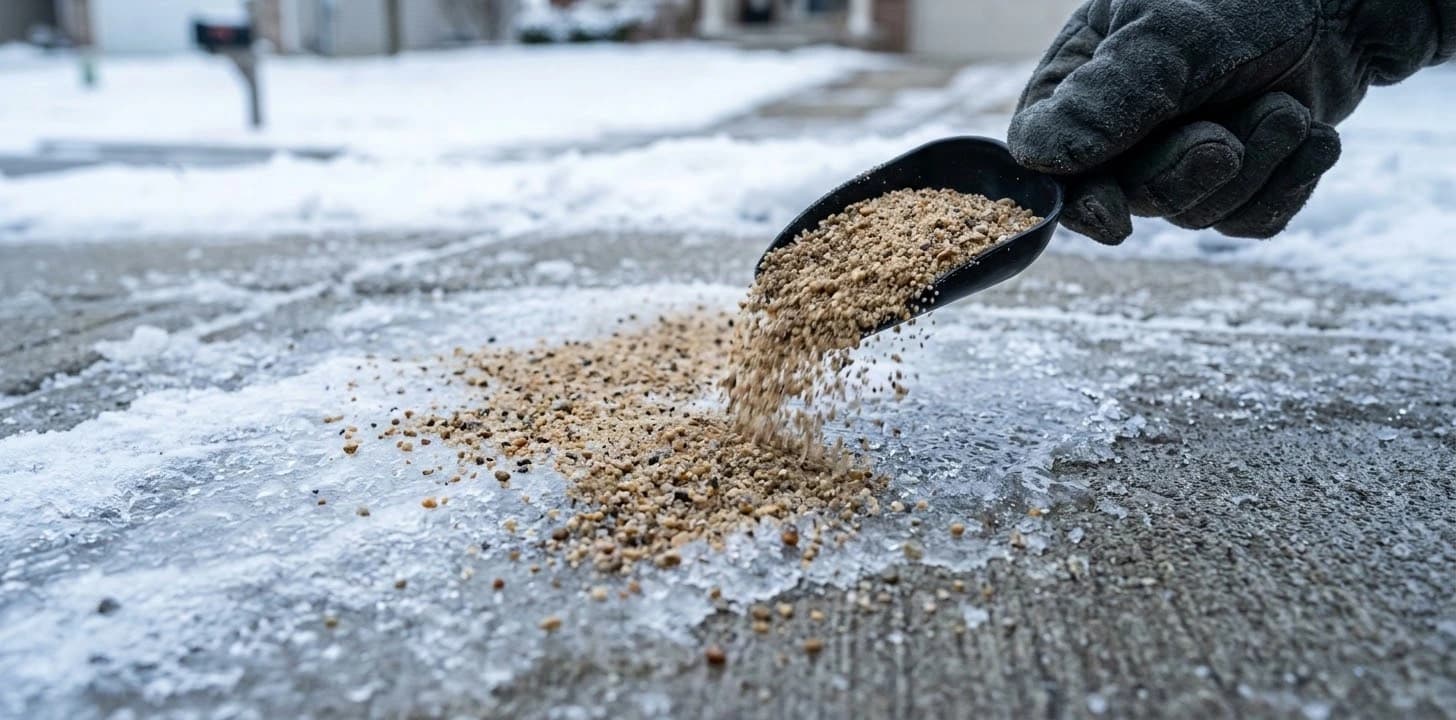
- Use plain sand for traction.
While sand won't melt the ice, it provides excellent grip for your tires and boots, ensuring safety without subjecting your concrete to devastating chemical and freeze-thaw damage. After the first two winters, your concrete will have cured enough to be slightly more resilient, but avoiding harsh chemicals altogether is always the safest bet.
Built to Survive: How J&J Engineers Concrete for Indiana Winters
While avoiding salt is your best defense, the true longevity of a driveway starts on the day it is poured. A cheap, builder-grade 3,000 PSI mix simply cannot withstand a Central Indiana winter.
That is why our 100% in-house, veteran crews engineer our driveways from the ground up to fight the elements:
1. 5% to 7% Air Entrainment
This is our secret weapon for freeze-thaw concrete protection in Central Indiana. We introduce an air entrainment additive into our mix, which creates millions of microscopic air bubbles inside the concrete. When water inevitably gets into the concrete and freezes, these bubbles act as tiny pressure relief valves, giving the ice room to expand without breaking the slab.
2. High-Strength 4,500 PSI Mix & Fiber Mesh
We refuse to pour weak concrete. Every J&J driveway is upgraded to a 4,500 PSI mix and infused with Fiber Mesh additives to prevent the micro-cracking that winter weather loves to exploit.
3. A Draining Foundation
Trapped water under the slab causes "frost heave," pushing the concrete up and cracking it. We prevent this by excavating failing subgrades and installing a mechanically compacted 4-to-6-inch base of #53 crushed limestone to ensure proper water drainage beneath the surface.
Protect Your Property with J&J General Solutions
We stand behind our installations with a 3-Year Workmanship Warranty that covers structural failures. However, it is vital to remember that this warranty strictly excludes salt damage and natural hairline shrinkage—which is exactly why proper winterizing is so crucial!
Is your current Fishers driveway already crumbling from years of salt damage? It might be time for a replacement. As a family-owned business serving Central Indiana since the early 2000s, we make getting a replacement easy and transparent. We have a strict flat-rate project minimum of $3,795.66 for anything under 150 sq. ft., and we never force you to sit through high-pressure, in-home sales pitches.
Ready to Upgrade to a Winter-Proof Driveway?
Skip the wait and get your exact price right now. Head over to our Free Interactive Instant Quote Builder to see exactly what a custom-engineered, durable driveway will cost for your home.
Build Your Free Instant QuoteRelated Articles & Guides

Concrete Driveway Repair or Replacement: When Should You Replace Your Driveway in Indianapolis?
Wondering if you should repair or replace your Greenwood or Westfield driveway? Learn how to test for structural failure, avoid useless patches, and get transparent pricing.

Why Your Indianapolis Driveway Cracks: Advice from J&J Concrete Contractors
Standard builder-grade concrete simply isn't built to survive Indiana's aggressive freeze-thaw cycles. Learn how our standard 4,500 PSI mix and #53 crushed limestone base prevent cracks.

Stamped Concrete vs. Pavers: Elevating Your Carmel or Fishers Backyard
Compare stamped concrete vs. pavers for your Central Indiana home. Learn why seamless 4,500 PSI stamped concrete outperforms interlocking pavers in freeze-thaw durability, weed prevention, and maintenance.